
(-)-General safety requirements
1. When starting the engine, the clutch and gear lever should be placed in the neutral position. When driving, you should send a signal to confirm that there is no one in front of you, and there is no other thing on the track or tires before driving. The track must be braked when parking.
2. People are not allowed to get on or off the locomotive or pass objects while driving, and they are not allowed to cross the locomotive and the towed machinery and equipment at the same time. Turning and lateral driving are prohibited when working on steep slopes. Do not skid in neutral when going down a big slope, and shift gears when a crawler locomotive goes up and down.
3. When the engine is running, no work is allowed under the locomotive. No repairs and adjustments are allowed while driving,
4. When crossing obstacles such as exposed pipes, cables, steel wire ropes, etc., they should be protected by paving wood or planks.
5. If there are underground pipelines, cables, buildings and structures during construction, they should stop immediately and report to relevant units and departments for handling. It is forbidden to drag, push, or shovel objects buried in the ground under unknown circumstances.
6. If the engine stops when working on a slope, the car must be braked and the track must be plugged. When the driver wants to leave the locomotive during work, he should drop the bucket or fork and turn off the engine.
7. Wire ropes are not allowed to be used as ropes. If the wire rope on the winch is kinked, it must be cleaned up in advance. If the wear and corrosion exceed the allowable limit, it should be replaced in time.
(2) Tractor
1. When the tractor is towing unmanned machinery and equipment, no one is allowed to sit on the towed object. Do not drive when there are people between the locomotive and the towed object. When using steel wire ropes to tow heavy objects, nearby people can only start and walk after they are far away.
2. The mechanical equipment to be towed should have firm connection facilities.
3. When hauling special components, a special person should be instructed.
(3) Bulldozer
1. When pushing the soil to the edge of the slope, the shovel must not push out the edge. And should not lift the shovel to reverse the car until the gear is changed.
2. When large rocks, obstacles or pits are added to the workplace, they should be removed or filled up in advance. When using bulldozers to remove buildings, trees, electric poles, etc. higher than the body, safety measures should be taken and favorable terrain should be selected.
3. When going down a steep slope, the dozer should be lowered to touch the ground, and the vehicle should be reversed to go down.
4. The dozer must be put down during maintenance. If you want to check under the shovel, you must use a wooden block to secure it. When the shovel is suspended in the air, it is strictly forbidden to leaning under the dozer for inspection or work.
(4) Scrapers
1. It is forbidden to walk and transport when the bucket is not fixed in the transport state. A safety wire rope must be installed between the Dongfanghong tractor and the bucket.
2. When the scraper is on a slope, it is forbidden to back down to unload the soil.
3. When the scraper is traveling and working, it is forbidden to carry people on the bucket or frame. After the machine-plate bucket is moved before the push plate is moved, it is strictly forbidden to work at the back of the bucket.
4. When working with multiple machines, the distance between the front and rear of the two machines should not be less than 20 meters.
5. For the handling of the bucket during maintenance and inspection operations, refer to the requirements for bulldozers (i.e., Article 4 of "Bulldozers").
(5) Excavator
1. In operation, the shovel should not be too deep, and the bucket should not be too strong. When the bucket is fully loaded, the inclination of the boom must not be changed.
2. During operation, it is strictly forbidden to rotate the bucket without leaving the working surface, or use the side of the bucket to smooth the soil, or use the bucket to impact the working surface from the side.
3. When digging a cliff, pay attention to the collapse of the rock to injure people or smash objects. When digging a trench, the station should keep a safe distance from the trench to prevent the vehicle from overturning.
4. When unloading soil on the car, the bucket should be low, try to put it in the car box and open the bottom to unload the soil. It is strictly forbidden for the bucket to pass over the cab of the car. When there are people or obstacles under the working face, it is forbidden to unload the soil.
5. When moving the excavator, the turntable should be braked, the boom should be parallel to the track, and the shovel head should not exceed 1 meter from the ground. When going uphill, the crawler driving wheel should be left behind, when going downhill, the crawler driving wheel is in front and the boom is behind. Generally, you should not go up and down a slope of more than 20 degrees,
6. When the excavator stops working, the bucket must fall to the ground and must not be suspended in the air.
7. Observe when operating hydraulic excavators.
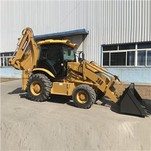
(6) Universal loading and unloading machine
1. Can not exceed the specified load capacity for loading and unloading. Even though the arm is not overweight but the size is too large and the center of gravity is unstable, it cannot be carried.
2. It is forbidden to lift goods when the lift is tilted forward, and it is not allowed to drive when the lift is not fully tilted backward. Lifting objects must be carried out after braking. When driving, the lowest point of the bucket or fork should be 300-400 mm away from the ground, and there must be no people on the bucket or fork.
3. When picking up the goods with a bucket, the first gear should be used to move forward at a low speed within 8 to 4 meters from the goods. If you need to push the goods, you should not use too much force.
4. The center of gravity of the cargo should be in the middle of the two wishbone. It is forbidden to use one wishbone to lift the goods.
5. When the rear wheel is off the ground after losing stability, the heavy object should be dropped immediately.